


Introduction
Creating an online course and building a learning business are closely related, but they are not exactly the same.
An online course is a learning product. It organizes knowledge, lessons, activities, and resources around an intended learner outcome.
A learning business includes the course, but also considers the wider system around it: the audience, brand, discovery process, enrollment journey, student relationships, and ongoing improvement.
This does not mean that every creator must immediately build a complete business. A standalone course may be the right way to test an idea, support an existing service, train a particular group, or deliver one focused learning experience.
The distinction becomes useful when you want to move beyond publishing content and create a longer-term relationship between your expertise, educational offers, and learners.
What is an online course?
An online course is a structured educational product delivered through the internet. It is designed to help a particular group of learners develop knowledge, skills, or practical understanding.
Depending on its purpose, an online course may include:
Modules and lessons
Video, audio, text, or presentations
Downloadable resources
Practical examples
Learning activities
Quizzes or assessments
A defined learning outcome
A method for accessing the content
A strong online course is not simply a collection of videos or information. Its content should form a coherent learning path.
Learners should be able to understand what the course is intended to help them achieve, how its lessons connect, what they should practice, and how they can evaluate their progress.
An online course can exist in different contexts. It may be published through a third-party marketplace, offered as part of a coaching or consulting service, used for internal training, or presented through the creator’s own branded website.
It may also be free or paid.
The course itself remains the educational product regardless of where it is hosted or how learners access it.
When creators are ready to organize their material, course-management tools for modules, lessons, resources, and quizzes can help transform their expertise into a structured learning experience.
What is a learning business?
“Learning business” does not have one universally standardized definition. In this guide, we use the term to describe a business built around helping a defined audience achieve meaningful learning outcomes through connected educational offers, branding, enrollment, delivery, student relationships, and continuous improvement.
A course may be the first and most important product within that business, but it is not the entire system.
A learning business may connect:
One or more courses or educational offers
A clearly defined audience
A recognizable brand
A branded learning destination
Educational and marketing content
Sales and enrollment processes
Course access and delivery
Student communication
Feedback and progress information
Related or future learning offers
This broader view is consistent with general business planning. A business is not defined only by the product it sells. It must also consider the people it serves, the value it provides, how customers discover it, how relationships are maintained, and how the business operates.
The U.S. Small Business Administration’s business-planning guidance similarly identifies elements such as customer segments, value propositions, customer relationships, marketing, sales, costs, and revenue streams.
For a creator, this means that producing a valuable course is essential—but additional decisions are required when that course becomes part of a broader business.
Our guide to building a learning business around your expertise explores that complete process in more detail.
A branded Learning Hub can then provide a consistent destination where learners discover courses, understand the creator’s identity, enroll, and access their learning experience.
Online course vs. learning business at a glance
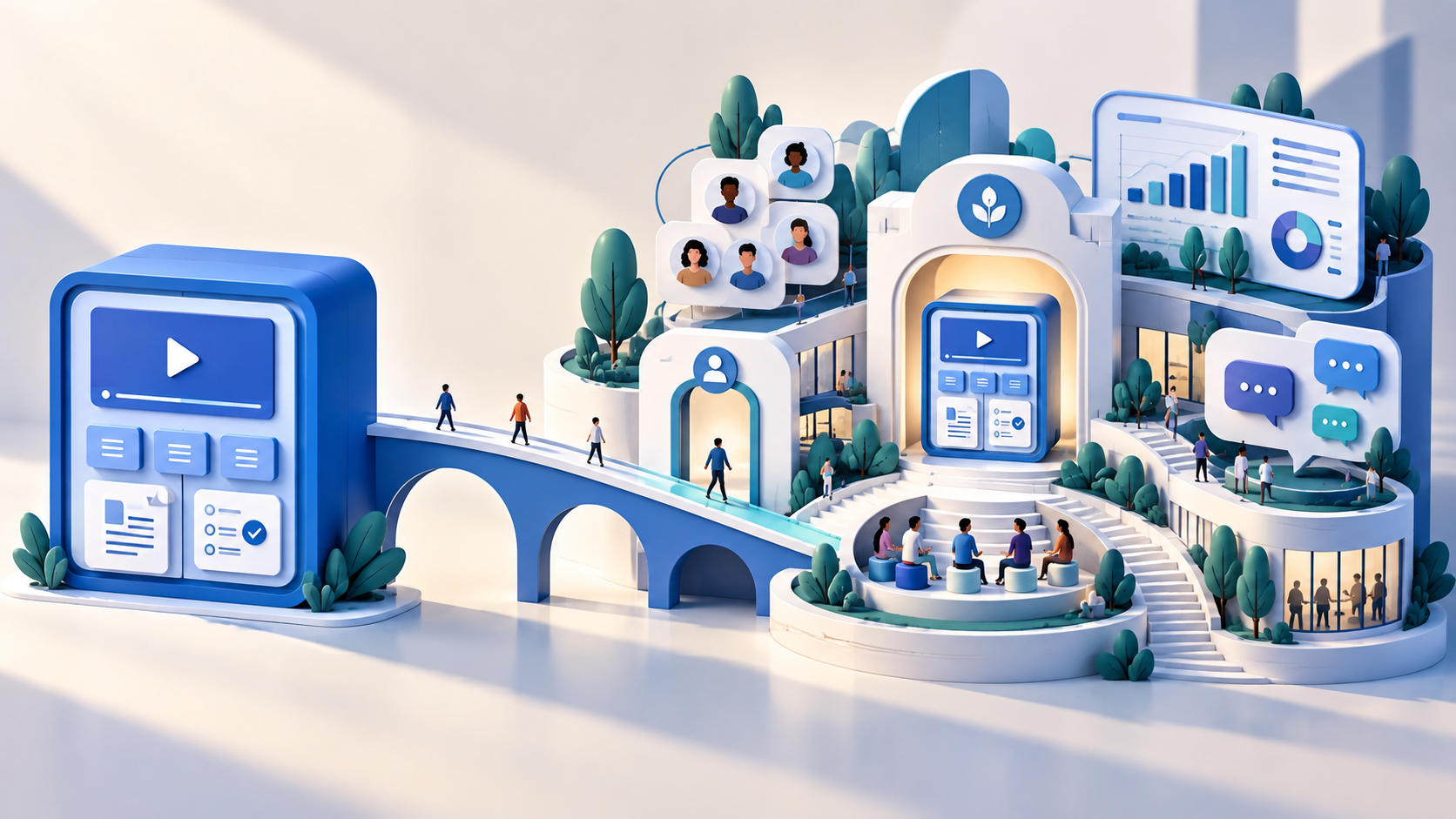
The simplest distinction is that an online course is an educational product, while a learning business is the connected system surrounding one or more educational products.
Online course | Learning business |
|---|---|
A specific educational product | The wider system surrounding one or more learning offers |
Focuses on lessons and learning outcomes | Connects the audience, brand, offers, enrollment, delivery, and improvement |
May be hosted on a marketplace or course platform | Develops a recognizable destination and business identity |
May depend on an existing platform or audience | Builds its own discovery channels and audience relationships |
May end when the content is published | Continues through enrollment, delivery, feedback, and future offers |
Evaluates whether the course serves learners | Also evaluates how the wider learner journey and business operate |
These are not competing models.
An online course can exist without becoming a complete learning business. It can also become the first product and foundation of one.
The right direction depends on what the creator wants to accomplish.
Seven practical differences between an online course and a learning business
1. Product vs. system
An online course is a product designed to support a particular learning outcome.
A learning business connects that product to the systems required to present, deliver, and improve it. These may include the creator’s website, educational content, sales page, enrollment process, student access, communication, and feedback.
The course remains central. The wider system helps the right learners discover and use it.
2. Subject vs. defined audience need
A course idea often begins with a subject the creator understands, such as leadership, photography, fitness, marketing, or software development.
A learning business goes further by identifying who needs that knowledge, what problem they are trying to solve, and what meaningful progress the learning experience should support.
The creator moves from asking, “What can I teach?” to asking, “Whom can I help, and what do they need from me?”
3. Course identity vs. recognizable brand
A course may have a title, cover image, and description without being part of a broader brand.
A learning business creates a consistent identity across its courses, pages, educational content, instructor information, communication, and student experience.
A brand is more than a logo or color palette. It represents what learners expect from the creator’s expertise, values, teaching approach, and learning experiences.
Creators do not need to build a complicated website from the beginning. However, the ability to create branded pages without coding can become valuable as the business develops.
4. Publishing vs. discovery
Publishing a course makes it available. It does not automatically help suitable learners find it.
A learning business considers how its intended audience will discover the creator and understand the offer.
Discovery may come through:
Educational articles
Search engines
Social content
Professional communities
Email communication
Workshops
Referrals
Existing clients or students
The objective is not to attract everyone. It is to help relevant learners find useful information and decide whether the course fits their needs.
5. Course access vs. enrollment journey
Providing course access is one part of the learner experience.
The complete enrollment journey begins earlier. A prospective learner must understand:
Who the course is for
What it is intended to help them learn
What it includes
What it requires from them
Whether it is free or paid
Who created it
What happens after enrollment
After deciding to enroll, the learner should receive clear access and know how to begin.
A connected process reduces unnecessary confusion between discovering the course, evaluating it, enrolling, and starting the learning experience. Learmo’s monetization and sales-funnel tools are designed to connect these stages.
6. Course activity vs. informed improvement
Course activity can show creators which lessons learners access, where progress slows, or how learners respond to assessments.
These patterns are useful, but they do not automatically explain why something happened.
If learners stop at a particular lesson, the content may be difficult, unclear, inaccessible, unnecessary, or poorly aligned with their goals. The creator should combine activity information with questions, comments, feedback, assessment results, and professional judgment.
A creator dashboard for understanding student and course activity can support this evaluation, but the creator remains responsible for interpreting the information and deciding what to improve.
7. One offer vs. an evolving direction
A standalone course may continue serving its intended purpose without expanding into anything else.
A learning business may gradually develop a wider direction. For example, learner questions might reveal the need for a foundational course, an advanced course, a practical workshop, or additional resources.
Expansion should not happen simply to increase the number of products. New offers should address genuine needs and fit the creator’s expertise and broader purpose.
One focused and useful course is a stronger foundation than a large collection of disconnected content.
Do you need a learning business to create an online course?
No. You can create and publish an online course without establishing a complete learning business.
A standalone course may be appropriate when you want to:
Test a course idea
Support an existing service
Teach an internal or private group
Deliver a one-time educational resource
Use an established marketplace
Begin without creating a broader business structure
Not every educator wants to become an entrepreneur. Someone may create a course to share knowledge, support a community, train employees, supplement classroom instruction, or serve existing clients.
Building a learning business becomes more relevant when you want to:
Develop a long-term educational brand
Maintain direct relationships with learners
Publish related learning offers
Build your own discovery channels
Manage enrollment under your identity
Learn from student feedback and activity
Connect course creation with a wider business direction
You do not need to make this decision permanently before creating your first course.
You can begin with one valuable learning experience and decide whether a broader business is appropriate as you understand your learners and goals more clearly.
When does an online course begin becoming a learning business?
There is no single technical point at which an online course becomes a learning business.
The transition is usually gradual.
Your course may be developing into a learning business when:
You have identified a specific audience.
Your course addresses a genuine learner need.
Your brand has a clear educational purpose.
Learners can discover and evaluate your offer.
Enrollment and access form a coherent journey.
You maintain an ongoing relationship with students.
You collect feedback and improve the experience.
Your first course fits within a broader direction.
You do not need multiple courses, a large team, or an advanced technical system to begin.
A creator with one focused course, a defined audience, a trustworthy brand, and a clear learner journey may have a stronger foundation than someone with many disconnected courses.
Legal registration, tax obligations, consumer-protection responsibilities, and business requirements vary by jurisdiction. Creators should obtain qualified local guidance about the requirements that apply to their circumstances.
Is a learning business the right direction for you?
Use these questions to evaluate your current goal:
Am I creating one educational product or establishing a broader direction?
Who specifically is the intended learner?
What meaningful outcome should the course support?
Where will learners discover and understand the offer?
Will the course appear under my own brand?
How will enrollment and access work?
How will I communicate with students?
What feedback and learning information will I review?
Could this course naturally lead to related learning experiences?
You do not need every answer before beginning.
The purpose of these questions is to reveal the difference between creating course content and designing the complete environment around it.
If your immediate objective is to test an idea, begin with a focused course or pilot. If your goal is to develop a long-term educational brand, consider how each early decision could support the wider learner relationship.
Start with the course, but design for the relationship
A learning business does not require a large course library, a large audience, or a complicated technology stack.
It can begin with one credible area of expertise, one defined audience, one genuine need, and one focused course.
Course quality remains essential. Branding, marketing, or sales processes cannot compensate for an experience that does not serve its learners.
The broader learning-business perspective helps connect that course to the people and processes around it: how learners discover the creator, understand the offer, enroll, access the experience, provide feedback, and continue their relationship with the brand.
You can build that system one decision at a time.
An online course can be your first learning product. Learmo helps connect that course with your brand, Learning Hub, enrollment journey, students, and AI-assisted creation in one platform. Learmo is currently available through a controlled Beta Program.
Apply to join the Learmo Beta Program and begin building your learning business under your own brand.